
How to Choose the Right PLC for a Packaging Machine
Table of Contents
That distinction matters. A case sealer with two conveyors and several pneumatic cylinders has little in common with a high-speed flow wrapper that must register printed film, synchronize sealing jaws, manage recipes, and exchange production data with a line controller. Both are packaging machines, but they do not need the same control architecture.
The practical way to choose is to define the machine first, then eliminate PLCs that cannot meet its non-negotiable requirements. Price comparison comes later.
Quick Answer: Match the PLC to the Machine Profile
Use this table as a starting point, not as a substitute for an I/O list and timing study.
| Packaging machine profile | Typical control demands | Controller direction |
|---|---|---|
| Case sealer, simple conveyor, basic indexing table | Mostly discrete I/O, a few VFDs, simple sequence, local HMI | Compact PLC with suitable built-in I/O and Ethernet |
| Filler, capper, labeler, checkweigher interface | Faster inputs, analog signals, recipes, one or more positioned axes | Expandable compact PLC or machine controller with high-speed functions |
| Form-fill-seal machine, flow wrapper, cartoner | Registration, coordinated servo axes, electronic camming, deterministic timing | Motion-capable PLC/PAC or machine automation controller |
| Case packer, robotic cell, palletizer | Robot interface, coordinated zones, safety I/O, remote I/O, line integration | Scalable controller with motion, networked safety, and strong diagnostics |
| Multi-machine packaging line | Large device count, line coordination, data collection, redundancy or segmented networks | Modular PLC/PAC architecture, sometimes with separate machine controllers |
A compact PLC can control a sophisticated machine when its integrated functions match the application. A larger PLC can still be the wrong choice if it lacks the required motion bus, local support, or safety architecture.
1. Define the Packaging Process Before Selecting Hardware
Begin with a one-page functional description of the machine. List what enters, what happens to it, and what leaves. Include normal production, startup, stop, changeover, cleaning, manual operation, recovery after a jam, and maintenance modes.
For example, a vertical form-fill-seal machine may need to:
- Unwind and tension film
- Detect a registration mark
- Pull a precise film length
- Coordinate vertical and horizontal sealing
- Trigger filling at the correct position
- Reject an incomplete package
- Store product recipes
- Report production counts and downtime reasons
This description reveals control requirements that a raw I/O count will miss. Registration demands fast capture and deterministic response. Coordinated sealing may require electronic camming. Recipe changes affect memory, HMI design, and data handling. Jam recovery affects machine states and software structure.
If the customer’s factory uses PackML, include that requirement at the beginning. OMAC describes PackML as a consistent method for machine states, modes, and data exchange. It does not dictate a PLC brand, but the selected controller must have enough program structure, memory, data types, and communication capacity to implement it cleanly.
2. Build a Real I/O List
Do not select the CPU from an estimated total such as “about 40 inputs.” Create a point-by-point I/O list and classify every signal.
| I/O list field | Why it matters |
|---|---|
| Device and function | Prevents omitted sensors, valves, and diagnostics |
| Digital, analog, temperature, encoder, or smart device | Determines the module type |
| Voltage and signal type | Separates 24 VDC, relay, thermocouple, RTD, 0-10 V, and 4-20 mA requirements |
| PNP/NPN or sourcing/sinking | Prevents incompatible field wiring |
| Normal or safety-related | Keeps standard and safety architectures separate |
| Required response time | Identifies high-speed inputs and outputs |
| Local or remote location | Affects cabinet layout and network design |
| Spare or future point | Preserves realistic expansion capacity |
Count More Than Sensors and Solenoids
Packaging projects often miss I/O associated with diagnostics and auxiliary equipment. Include guard status, air pressure, vacuum switches, film-low sensors, reject confirmation, drive-ready and drive-fault signals, printer status, vision results, stack lights, cabinet temperature, and maintenance bypass indications where permitted by the safety design.
Some devices may exchange data over an industrial network instead of hardwired I/O. They still consume controller resources, network bandwidth, memory, and engineering time. Add them to the device list even if they do not add terminal points.
- Related Product
Need a Replacement Altivar Drive?
Browse new original Altivar drives for maintenance, troubleshooting, and replacement projects.
- New original parts
- Fast response
- Global shipping
Leave an Engineering Allowance
Many engineers reserve roughly 15% to 25% additional I/O and usable panel capacity on a machine that is likely to change. This is a practical design allowance, not a universal manufacturer rule. The appropriate margin depends on whether the machine design is frozen, whether customer options will be added, and how difficult future expansion would be.
Check expansion at three levels:
- Does the CPU support enough local and remote I/O modules?
- Can the power supply and system bus support the proposed modules?
- Is there physical DIN-rail, terminal, cable-duct, and enclosure capacity?
A controller that supports another eight modules on paper does not help when the cabinet has no space or the selected power arrangement cannot supply them.
3. Calculate the Required Response, Not Just PLC Scan Time
Packaging speed should be translated into a response-time budget. “High speed” is not a specification.
The total control response may include:
Sensor response and input filtering
+ input-module update time
+ network update time, if remote
+ PLC task or scan time
+ motion or logic processing
+ output-module update time
+ actuator or drive response
= total machine response
PLC scan time is only one part of this chain.
Suppose a film moves at 1 m/s and registration correction must begin within 2 mm of mark detection. The available control window is only 2 ms before considering sensor delay and actuator behavior. A normal cyclic input read in a heavily loaded task may be inappropriate; a high-speed input, timestamp, hardware latch, or motion-network function may be required.
For each critical event, record:
- Maximum line or film speed
- Product pitch
- Required position tolerance
- Sensor response time and input filter setting
- Local or networked I/O update time
- Task period and worst-case execution time
- Drive command and mechanical response
Ask the PLC supplier for worst-case or configured performance, not only the smallest published instruction time. Communication load, motion tasks, data logging, HMI polling, and diagnostics all affect the completed application.
Before releasing the design, prototype the fastest sequence with the intended CPU, I/O, drive, network cycle, and realistic program load.
4. Separate Simple Positioning from Coordinated Motion
The number of servo motors alone does not define the motion requirement. Four independent index axes can be easier than two axes that must remain electronically geared at high speed.
Create an axis table with these fields:
- Axis function
- Servo, stepper, VFD, or pneumatic actuator
- Independent or synchronized motion
- Position, speed, or torque control
- Registration input requirement
- Electronic gearing or camming
- Homing method
- Encoder type and feedback path
- Safety functions required at the drive
- Maximum update period and accuracy requirement
When Pulse-Train Positioning May Be Enough
Pulse and direction control can suit a small number of independent axes where the PLC and drive support the required pulse rate and signal type. It may be reasonable for an indexing conveyor, simple cut-length axis, or occasional changeover adjustment.
Check the exact transistor-output CPU and axis limits. Relay outputs cannot generate high-speed positioning pulses, and a family brochure may describe functions that are available only on specific CPUs or expansion modules.
When a Real-Time Motion Network Is the Better Choice
Use a motion-capable PLC or machine controller when the machine needs coordinated axes, electronic cam profiles, registration correction, interpolation, high-speed diagnostics, or tightly synchronized I/O. Platforms may use EtherCAT, PROFINET IRT, Sercos, SSCNET, or another deterministic vendor-supported network.
Verify these items for the exact CPU and license:
- Maximum physical, controlled, and synchronized axes
- Supported servo-drive families
- Minimum configurable motion cycle
- Cam, gearing, interpolation, and registration functions
- High-speed input integration
- Safety communication and safe-motion compatibility
- Axis commissioning and diagnostic tools
Do not assume that ordinary Ethernet communication to a servo drive provides deterministic coordinated motion. The controller, drive, protocol, and engineering software must support the required real-time motion architecture as a system.
5. Let the Risk Assessment Define the Safety System
Safety is not an optional PLC feature to add after the electrical drawings are complete.
Start with a machine risk assessment. Identify hazards around sealing jaws, knives, augers, conveyors, pneumatic mechanisms, robots, and stored energy. Define each required safety function, such as emergency stop, guard interlocking, prevention of unexpected startup, safe stop, or safely limited speed.
The required Performance Level or Safety Integrity Level must be determined using the applicable standards and market requirements. ISO 13849-1:2023 covers the design and integration of safety-related parts of control systems. IEC 62061:2021, with its applicable amendments, addresses functional safety of machinery control systems. In North America, ANSI/PMMI B155.1-2023 is specifically relevant to packaging and processing machinery.
Only after that work should you decide between safety relays, a separate safety controller, or an integrated safety PLC with safety I/O and safe network communication.
An integrated safety PLC is often attractive when the machine has several guards, zones, drives, or operating modes. It can improve diagnostics and reduce hardwiring. A small machine with a limited number of straightforward safety functions may be adequately served by properly selected safety relays. Neither choice is automatically correct.
Do not implement a required safety function in a standard PLC unless the complete design is permitted and validated under the applicable safety architecture. A controller carrying a safety designation also does not make the machine compliant by itself. Sensors, actuators, wiring, diagnostics, software, verification, and validation all belong to the safety function.
- PLC Solutions
Find the Right PLC for Your System
Explore new original PLC CPUs, I/O modules, power supplies, and communication units for maintenance and automation projects.
- New original parts
- Fast response
- Global shipping
6. Map Every Communication Connection
A packaging PLC rarely communicates only with the HMI. Create a network and protocol schedule before choosing the CPU.
Typical connections include:
- HMI or industrial panel PC
- Servo drives and VFDs
- Remote I/O and valve manifolds
- Vision systems and barcode readers
- Checkweighers and metal detectors
- Label printers, coders, and RFID equipment
- Robots and intelligent conveyors
- Temperature controllers and weighing instruments
- SCADA, historian, MES, or line controller
- Engineering and remote-service access
For each device, write down the exact protocol, physical interface, role, update requirement, and expected data volume. “Ethernet” is not a protocol. EtherNet/IP, PROFINET, Modbus TCP, SLMP, OPC UA, raw TCP sockets, and EtherCAT have different purposes and controller requirements.
Native interfaces usually reduce gateways, wiring, software effort, and troubleshooting. However, count the PLC’s available connections and communication resources. Built-in Ethernet does not mean unlimited HMI, programming, socket, web, and production-data sessions.
If the machine must connect to the plant network, discuss network segmentation, user access, secure remote service, backups, and patch responsibility with the end user. Keep deterministic machine-control traffic separate from noncritical data traffic where the architecture requires it.
7. Size Memory and Data Functions for the Finished Machine
Program memory is only part of the requirement. Packaging machines may store hundreds of recipes, alarm histories, reject records, production counters, calibration values, audit data, and batch information.
Check:
- Program and data memory
- Retentive data capacity and write limitations
- Recipe handling method
- SD or removable-memory support
- Data logging and timestamp resolution
- Real-time clock behavior and time synchronization
- File transfer and backup options
- OPC UA, MQTT, database, or MES requirements
- User management and audit functions, when required
Decide which data belongs in the PLC, HMI, edge device, or plant system. Turning the PLC into a long-term historian can consume resources and complicate recovery. Conversely, storing a critical machine recipe only in an HMI can create a single point of failure.
8. Check Environmental and Electrical Compatibility
Use the official hardware manual for the exact model and modules. Verify:
- Supply voltage and power budget
- Operating temperature, humidity, altitude, vibration, and shock limits
- Required enclosure rating and pollution environment
- EMC, grounding, and cable-separation instructions
- Agency approvals required by the destination market
- Conformal coating or special environmental versions, if needed
- Terminal style and removable connector availability
- Heat dissipation and cabinet ventilation
Food and beverage packaging may introduce washdown, condensation, cleaning chemicals, and temperature changes. An IP20 PLC normally remains inside a suitable enclosure; on-machine IP-rated I/O may reduce long sensor cable runs. The complete installation must meet the hygienic, environmental, and regulatory requirements of the machine, not merely the PLC specification.
Also confirm output compatibility. Solenoid inrush, contactor coils, lamps, and valves may need interposing relays, suppression, or separately protected power groups. Do not size the PLC output only from the device’s steady-state current.
9. Evaluate Software, Diagnostics, and Maintainability
The cheapest PLC hardware can become the most expensive choice if the plant cannot support it.
Ask these questions:
- Does the customer’s maintenance team already use this platform?
- Is the programming software licensed, subscription-based, or freely available?
- Which software version supports the selected CPU and firmware?
- Are ladder, structured text, function blocks, and motion tools available as needed?
- Can the software simulate the logic or motion application?
- Are device configuration and diagnostics integrated?
- Can source code, comments, libraries, and passwords be delivered to the owner?
- Are replacement parts and trained support available in the installation region?
- What is the product lifecycle status?
Good diagnostics reduce downtime more effectively than spare CPU performance that is never used. Prefer a platform that can show a failed remote-I/O node, drive fault, safety demand, network break, and invalid configuration clearly from the HMI or engineering software.
Standardize naming, machine states, alarm structures, and reusable code across machines where possible. PackML can help plants establish consistent states and data, but it still requires disciplined implementation and sufficient controller resources.
- HMI Replacement
Upgrade or Replace Your HMI
Find compatible HMI panels for discontinued models, machine upgrades, and operator interface replacement.
- New original parts
- Fast response
- Global shipping
10. Compare the Complete Platform, Not Brand Names
Several current controller families can be appropriate for packaging applications. The correct choice depends on the exact CPU, firmware, modules, software, and regional support.
| Platform example | Where it may fit | Points to verify |
|---|---|---|
| Mitsubishi MELSEC iQ-F FX5U/FX5UC | Compact machines needing built-in communications, high-speed functions, and a path to positioning or motion modules | CPU output type, axis function, module compatibility, connection limits, software version |
| Omron NX1P | Compact machine automation using EtherCAT and EtherNet/IP with expandable NX I/O | Exact SKU axis counts, task period, I/O capacity, safety architecture, Sysmac software requirements |
| Siemens SIMATIC S7-1200 G2 | Compact and modular machines using PROFINET, integrated motion, and optional fail-safe CPUs | CPU capability, technology-object limits, PROFINET device count, panel/module compatibility, TIA Portal version |
| Schneider Electric Modicon M262 | Logic or motion machines needing Modbus TCP, EtherNet/IP, scalable I/O, and motion variants | Logic versus motion CPU, synchronized-axis requirement, Sercos architecture, safety and software configuration |
| Rockwell Automation CompactLogix family | Small to mid-sized machines in plants standardized on EtherNet/IP and integrated Logix tools | Exact controller motion/safety support, I/O family, network capacity, Studio 5000 edition and version |
These are examples, not an interchangeability list. Even products within one family can differ in built-in I/O, output type, memory, motion axes, safety certification, network ports, and supported expansion.
The plant’s installed base often deserves substantial weight. Reusing familiar software, spare modules, code libraries, network standards, and technician knowledge can reduce commissioning and recovery time. It should not override a genuine motion, safety, or performance gap.
11. Calculate the Real System Cost
Compare the complete control bill of materials, not only the CPU price.
Include:
- CPU, power supply, I/O, terminal bases, and memory card
- Communication and motion modules
- Safety CPU, safety I/O, relays, and safe network components
- HMI, industrial switch, gateways, and remote I/O
- Programming and runtime software licenses
- Servo-drive commissioning tools and cables
- Panel space, wiring, and assembly labor
- Engineering, simulation, commissioning, and training
- Recommended spares and expected lifecycle support
A slightly more capable CPU may lower total cost if it removes several option modules and reduces engineering effort. The opposite can also be true: buying an advanced motion controller for a basic conveyor may add software cost and maintenance complexity with no production benefit.
Downtime changes the calculation. A proprietary low-cost controller with no local spare may be a poor choice for a machine that stops an entire packaging line.
Kwoco can help check a proposed BOM or replacement against full model numbers, communication modules, I/O types, terminal accessories, and software generation. Providing the electrical drawing, axis list, network list, destination country, and photos of an existing panel makes compatibility checking much more reliable than requesting “a PLC with 64 I/O.”
12. Use a Formal Selection Worksheet
Complete this checklist for every candidate CPU.
Machine Requirements
- [ ] Maximum production speed and product pitch defined
- [ ] Operating modes, changeover, cleaning, and recovery described
- [ ] All standard, safety, analog, temperature, and high-speed I/O listed
- [ ] Every motion axis classified as independent or synchronized
- [ ] Registration, camming, gearing, and interpolation requirements defined
- [ ] Safety functions and required PLr/SIL determined by risk assessment
- [ ] HMI, drive, remote I/O, vision, robot, printer, and plant protocols listed
- [ ] Recipe, traceability, logging, and data-retention requirements defined
Candidate PLC Checks
- [ ] Exact CPU and firmware support the required features
- [ ] I/O electrical types match the field devices
- [ ] Local and remote expansion limits are sufficient
- [ ] Worst-case task, I/O, network, and motion response meet the budget
- [ ] Motion axes and functions are supported without hidden license gaps
- [ ] Safety components and architecture meet the validated design
- [ ] Communication ports, sessions, and protocol roles are sufficient
- [ ] Memory and data functions have useful headroom
- [ ] Environmental ratings and approvals suit the installation
- [ ] Programming software, licenses, cables, and support are available
- [ ] Complete BOM fits the cabinet power, heat, and space limits
- [ ] A proof-of-concept has tested the highest-risk functions
Common PLC Selection Mistakes on Packaging Machines
Selecting by I/O Count Alone
Two PLCs with the same point count may have completely different high-speed, motion, safety, and communication capabilities. Count I/O, but classify it and connect it to the timing study.
Treating Every Ethernet Port as Equivalent
An Ethernet connector may support programming and HMI communication but not the motion, safety, redundancy, or device protocol required by the machine.
Adding Safety After the Standard Control Design
Late safety decisions often force changes to drives, I/O, network architecture, cabinet space, and software. Complete the risk assessment early.
Assuming Family-Level Features Apply to Every CPU
Motion axes, fail-safe capability, memory, I/O type, protocol support, and connection limits often vary by suffix. Verify the exact order code.
Ignoring the Customer’s Maintenance Environment
A technically excellent controller can still cause long downtime when the plant lacks the software, cable, source code, spare parts, or trained personnel needed to diagnose it.
Skipping the Proof-of-Concept
Catalog specifications do not replace a test of the critical registration input, motion sequence, camera exchange, recipe transfer, or plant connection under realistic load.
Frequently Asked Questions
There is no standard number. Build a point-by-point list covering normal control, diagnostics, safety, analog signals, high-speed inputs, and customer options, then confirm the expansion and power limits of the exact PLC. A 15% to 25% spare allowance is a common engineering choice for machines likely to change, but it is not a manufacturer requirement.
Choose a motion-capable PLC, PAC, or machine controller when the application needs coordinated servo axes, electronic camming, registration correction, interpolation, or deterministic high-speed updates. A basic PLC with pulse outputs may be sufficient for a few independent positioning axes if its pulse rate, axis count, and timing meet the application.
No. The safety architecture must come from the machine risk assessment and required safety functions. A small machine may use properly selected safety relays, while machines with multiple zones, guards, operating modes, or safe-motion functions often benefit from a safety PLC. The complete safety system must be verified and validated to the applicable standards.
No single scan-time value fits every machine. Calculate the full response from sensor and input filtering through I/O updates, network cycles, PLC task execution, output delay, and actuator response. The critical registration, reject, cutting, sealing, or motion event should determine the required performance.
The best platform is normally the one that meets the exact motion, safety, I/O, and protocol requirements while remaining supportable at the customer’s plant. Mitsubishi, Omron, Siemens, Schneider Electric, Rockwell Automation, and other major platforms all have suitable controllers; compare exact CPUs and software ecosystems rather than brand names alone.
Power your projects with brand-new, original Omron, Mitsubishi, Schneider PLC – in stock, ready now!
A Practical Final Decision
Start with the machine’s mandatory requirements. Remove any PLC that cannot support the required electrical I/O, deterministic response, motion functions, safety architecture, or communication protocols.
Next, compare the remaining platforms for expansion, diagnostics, software, plant familiarity, lifecycle, and complete installed cost. Finally, test the highest-risk function before ordering the production hardware.
This process usually produces a better result than choosing a familiar CPU first and forcing every machine requirement around it. The final PLC should have measured headroom, but every extra feature should solve a credible engineering or maintenance need.
Official References
Contact Us
Just fill out your name, email address, and a brief description of your inquiry in this form. We will contact you within 24 hours.
Product Category
Hot Sale Products
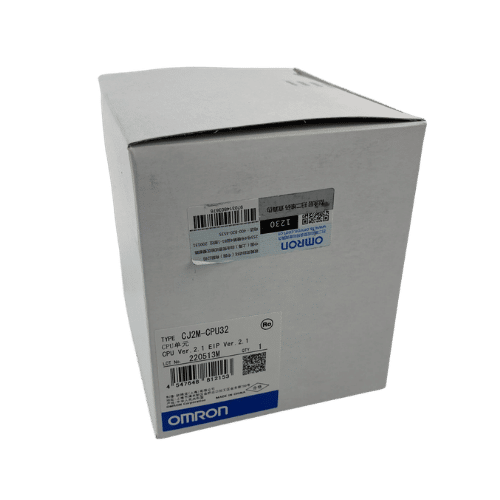
Omron CPU Unit CJ2M-CPU32
Omron PLC CJ1W-PA202 Supplier in China
Mitsubishi MR-JE Series 400w Servo Drive MR-JE-40A
Need a Fast Match?
Share your model or spec and our team will help you find the right fit-fast.
- Expert support
- Quick response
- Competitive price
- +86-755-81481609
- [email protected]
You May Also Find These Topics Interesting
CNC Machine Mastery: Understanding the Crucial Difference Between Feed Rate and Spindle Speed
This article dives deep into the intricacies of CNC machining, specifically focusing on two critical parameters: feed rate and spindle speed. While seemingly simple, understanding the difference
Understanding Analog Inputs in PLC Systems: Bridging the Gap Between Digital and Analog Signals
Analog inputs are the lifeline of modern automation systems, acting as the crucial link between physical processes and digital controllers like PLCs
What is a Timer in PLC, and How Does it Work?
What is a Timer in PLC, and How Does it Work? In the world of industrial automation, time is everything. Every process