
Omron CJ2M to CJ3M Migration: What Buyers Should Check Before Ordering
Table of Contents
A recommended replacement model is the starting point for a migration—not the complete purchasing specification. The order should cover the hardware and accessories needed for your machine, while engineering confirms how the application will be transferred and tested.
This guide separates Omron’s published transition information from the practical checks buyers should complete.
Information checked: September 21, 2026. Confirm current release status, documentation, and commercial availability before ordering.
What Omron Has Announced
Omron’s April 14, 2026 notice, 20260401_DOP_00001, identifies CJ3M as the CJ2M successor, with an autumn 2026 planned introduction. Although headed “Europe only,” it distinguishes these phase-outs:
| Existing family | Discontinuation scope stated | Final order entry | Last shipment |
|---|---|---|---|
| CJ2M-CPU3[] | Global | End of March 2027 | End of June 2027 |
| CJ2M-CPU1[] | European market only | End of June 2027 | End of September 2027 |
The notice maps CPU11–15 and CPU31–35 to corresponding CJ3M suffixes; for example, CJ2M-CPU33 → CJ3M-CPU33.
It announces program, I/O-unit, and wiring compatibility, with unchanged addressing and instruction sets. Listed changes include CF-to-SD storage, USB Type-B-to-Type-C, batteryless operation with an optional RTC battery, and built-in RS-232C for CJ3M-CPU3[].
The schedule is subject to revision, and the notice promises a detailed replacement guide. These announcements do not establish current stock or complete application approval. Omron: CJ2M Product Upgrade Notice, pages 1–3
- Related Product
Need a Replacement Altivar Drive?
Browse new original Altivar drives for maintenance, troubleshooting, and replacement projects.
- New original parts
- Fast response
- Global shipping
1. Identify the Complete Installed Configuration
Do not request a quotation using only “CJ2M replacement.”
Record the full CPU model and unit version, then inventory the attached equipment. Include the power supply, local and expansion I/O, communication units, serial option boards, and any pulse I/O modules.
The existing CJ2M lineup matters. Omron distinguishes CPU3[] models with built-in EtherNet/IP from CPU1[] models without it. Its lineup also identifies CP1W serial options for CPU3[] and version-dependent support for CJ2M pulse I/O modules. Omron: CJ2M Lineup
Build a configuration record that purchasing and engineering can share:
| Item | Information to capture |
|---|---|
| CPU | Full reference, unit version and machine identity |
| I/O | Complete module references, unit numbers and rack arrangement |
| Communications | Connected devices, interfaces, protocols and settings |
| Motion-related functions | Installed pulse modules, connected drives and application dependencies |
| Power and installation | Power-supply reference, loading record, dimensions and clearances |
| Application | Project version, software version and backup location |
Photographs help identify equipment, but they should supplement the drawings and configuration records.
2. Check Serial Connections Individually
Serial communication deserves its own review because a machine may depend on an HMI, barcode reader, temperature controller, or other device connected through a specific interface.
Omron’s CJ2M lineup includes RS-232C, RS-422A/485, and isolated RS-422A/485 option boards. Record the exact installed board rather than simply writing “serial port.”
For every serial connection, ask engineering to confirm:
- The required electrical interface.
- The protocol and communication settings.
- Connector arrangement and cable requirements.
- Any isolation requirements.
- The supported implementation on the proposed replacement.
RS-232C and RS-422A/485 are different electrical interfaces. Do not treat one as a direct substitute for the other merely because both carry serial communications.
If an interface change is necessary, identify the approved solution and include its hardware, configuration work, and testing in the migration scope.
- PLC Solutions
Find the Right PLC for Your System
Explore new original PLC CPUs, I/O modules, power supplies, and communication units for maintenance and automation projects.
- New original parts
- Fast response
- Global shipping
3. Confirm the Engineering Software Before Purchasing Hardware
Ask for the supported engineering software version and required updates for the exact CJ3M model offered.
A working CJ2M service laptop does not, by itself, demonstrate readiness to configure a new controller. Before committing to a shutdown date, establish that the responsible engineer can:
- Open and inspect the existing project.
- Select and configure the proposed CPU using supported tools.
- Follow the applicable migration procedure.
- Transfer the required application and settings.
- Diagnose communications and restore the approved configuration.
The official material reviewed for this article did not establish a minimum CJ3M software version. Obtain that requirement from current Omron documentation or technical support rather than relying on an unsupported version table.
Keep an untouched copy of the original project. Store migration work separately with a clear revision history.
4. Separate Program Transfer From Data Recovery
A machine’s operating state can involve more than its ladder program.
Before ordering, identify which data and settings the recovery package must preserve. Depending on the application, this may include recipes, calibration values, retained machine settings, communication configuration, and information held by connected devices.
Assign ownership for each item:
| Recovery item | Question to resolve |
|---|---|
| PLC project | Is the approved source available and accessible? |
| Machine data | Which values must be preserved, restored or verified? |
| Network configuration | Who maintains the device settings and connection records? |
| HMI application | Are the project and PLC communication settings available? |
| Storage media | What approved media and transfer procedure are required? |
| Time-dependent functions | Does the application rely on timestamps or clock retention? |
Do not assume that a memory-card image is a complete recovery package. Determine what the applicable procedure transfers and what must be handled separately.
5. Review EtherNet/IP and Other Connected Systems
For a networked machine, create a list of every device that exchanges data with the PLC.
Include HMIs, drives, remote I/O, supervisory systems, and other controllers. Record the protocol actually used; sharing an Ethernet connector does not establish that two devices communicate in the same way.
Ask the controls engineer to review:
- Device addresses and network topology.
- Connection definitions and data mappings.
- Engineering access requirements.
- Network and security settings.
- Startup, reconnection, and communication-loss behavior.
Make the test plan specific to the machine. “PLC communicates successfully” is too broad if the production process depends on several independent connections.
Avoid placing assumed security configuration steps in a purchase specification. Request the documented requirements and identify who will implement them.
- HMI Replacement
Upgrade or Replace Your HMI
Find compatible HMI panels for discontinued models, machine upgrades, and operator interface replacement.
- New original parts
- Fast response
- Global shipping
6. Order the Complete Migration Package
Request separate quotation lines for the CPU and any required accessories or services. This makes omissions visible before the equipment arrives.
| Purchase item | Confirmation required |
|---|---|
| Replacement CPU | Exact model, revision where relevant, condition and release status |
| Engineering connection | Supported cable, driver and software requirements |
| Storage | Approved media and required capacity |
| Serial communication | Supported interface arrangement and any additional hardware |
| Clock-related accessories | Whether the application requires an accessory |
| Retained equipment | Documented review of the installed I/O and related units |
| Delivery | Confirmed quantity, dispatch basis and destination |
| Documentation | Applicable manuals, replacement guide and offer-specific terms |
Where a supplier proposes an alternative to the requested model, have engineering approve it before order release. A similar reference should not silently replace the reviewed configuration.
7. Distinguish a Bridge Spare From a Migration Purchase
An urgent machine recovery and a planned controller migration are different projects.
A bridge-spare purchase aims to restore the existing approved configuration. A migration purchase also requires preparation, engineering work, and acceptance testing.
Compare the options using:
- Current component condition and machine criticality.
- Verified availability of suitable hardware.
- Completeness of backups and technical documentation.
- Engineering resources.
- Available shutdown time.
- The intended remaining service life of the machine.
Avoid buying excess legacy stock solely because a transition has been announced. Equally, do not schedule an immediate changeover before the replacement and recovery process have been reviewed.
8. Define Acceptance and Rollback Before the Shutdown
Agree on acceptance criteria before releasing the machine for modification.
The plan should cover the relevant I/O, communications, machine sequence, retained settings, alarms, and product-quality results. Include affected safety-function verification through the responsible machine-validation process.
Any electrical work or movement testing must follow the applicable equipment procedures and be performed by qualified personnel.
Document what happens if acceptance cannot be completed. Keep the original project, configuration records, and any hardware needed for the approved recovery plan available. Do not assume that rollback is automatic after other parts of the machine have been changed.
Frequently Asked Questions
A purchasing lifecycle notice is not a machine shutdown instruction. Review the machine’s condition, service strategy, applicable requirements, and manufacturer guidance when deciding when to migrate.
An evaluation-unit purchase may be reasonable if its purpose and limitations are explicit. A production migration order should identify unresolved requirements and avoid treating an evaluation purchase as approval for installation.
Establish an approved recovery route with the machine builder or responsible controls engineer before relying on a CPU purchase to restore operation. Hardware availability does not resolve missing application information.
Power your projects with brand-new, original Omron, Mitsubishi, Schneider PLC – in stock, ready now!
What to Send With Your RFQ
Provide the supplier with:
- Existing CPU model and unit version.
- Proposed replacement reference.
- Required quantity and destination.
- Required delivery date.
- Installed serial options and special modules.
- Engineering-confirmed accessory requirements.
- Any restrictions on revisions or substitutions.
- The documents required before order approval.
You can send the sourcing portion of this package to Kwoco for model-specific availability and lead-time confirmation. Keep machine compatibility and migration approval with the responsible engineering team.
Contact Us
Just fill out your name, email address, and a brief description of your inquiry in this form. We will contact you within 24 hours.
Product Category
Hot Sale Products
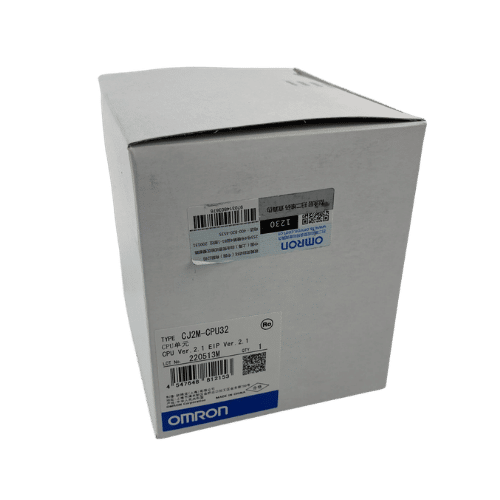
Omron CPU Unit CJ2M-CPU32
Omron PLC CJ1W-PA202 Supplier in China
Mitsubishi MR-JE Series 400w Servo Drive MR-JE-40A
Need a Fast Match?
Share your model or spec and our team will help you find the right fit-fast.
- Expert support
- Quick response
- Competitive price
- +86-755-81481609
- [email protected]
You May Also Find These Topics Interesting
Demystifying the Air Circuit Breaker: Your Comprehensive Guide
This article delves into the fascinating world of air circuit breakers (ACBs), explaining their function, types, working principles, and applications. Whether you’re
Everything You Need to Know About PLC Power Supplies
Power supplies are the unsung heroes of programmable logic controllers (PLCs), ensuring smooth operation by converting incoming electricity into the form and
Lenze i550 Error Codes and Reset Methods
When a Lenze i550 stops with an error, the four-character code is more useful than the red LED alone. It tells you