
Include the reflector, cable length and connector requirements in your inquiry so we can quote the parts you need together.
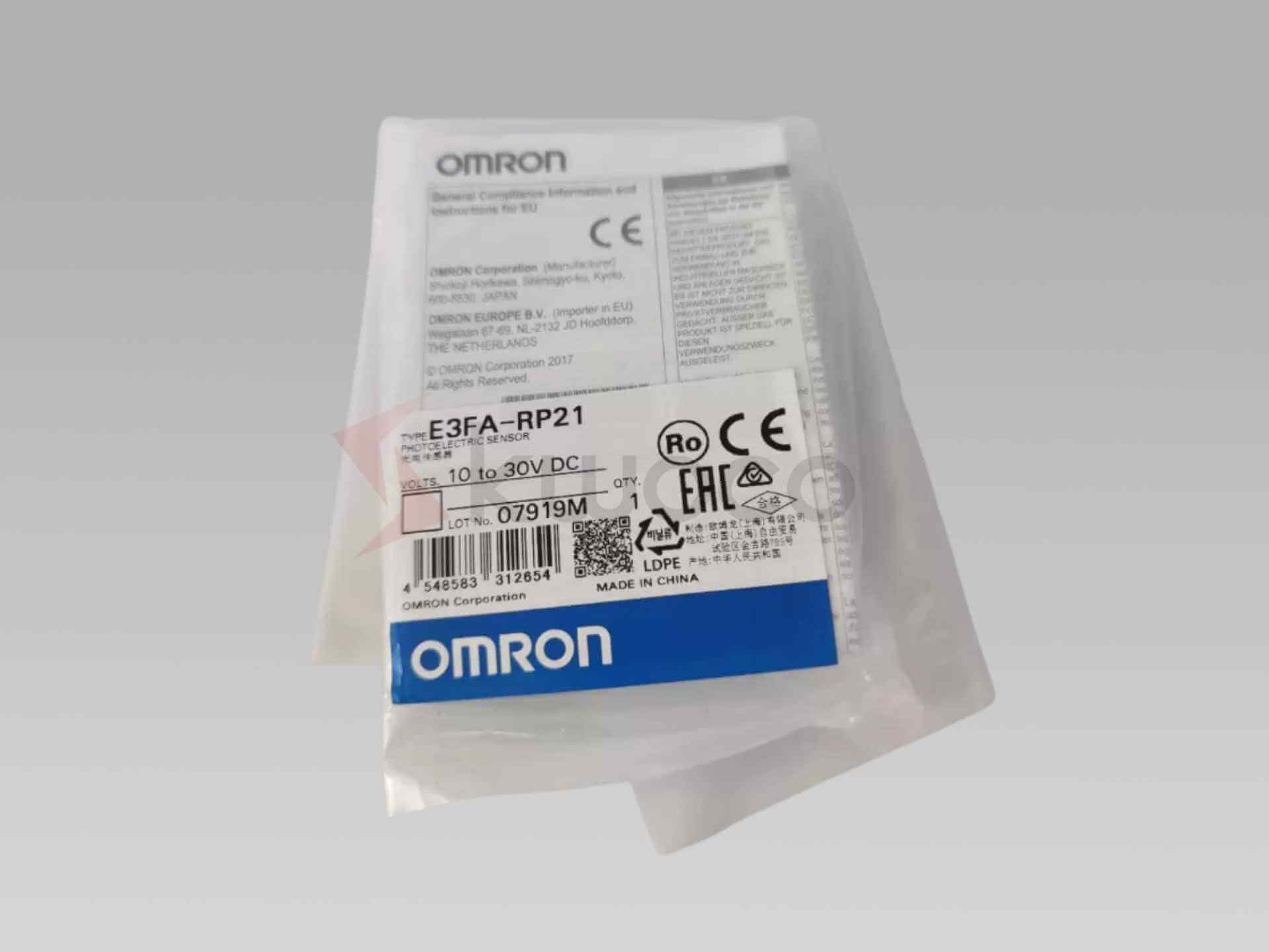
Omron E3FA-RP21 Photoelectric Sensor
M18 retro-reflective sensor with PNP output and an M12 connector. Sensing range: 0.1–4 m with the E39-R1S reflector, sold separately.
Request a quote by email
Usually quoted within 24 hours. Price and lead time confirmed by email.
We use your details to respond to this inquiry. Privacy policy ↗
E3FA-RP21 specifications
| Manufacturer / Model | Omron / E3FA-RP21 |
|---|---|
| Product Type | Retro-reflective photoelectric sensor with M.S.R. function |
| Sensing Distance | 0.1–4 m with E39-R1S reflector |
| Standard Sensing Object | Opaque object, 75 mm diameter minimum |
| Supply Voltage | 10–30 VDC; maximum 10% peak-to-peak ripple |
| Control Output | PNP open collector; 100 mA maximum, 30 VDC maximum; residual voltage ≤3 V |
| Operating Mode | Light-ON / Dark-ON, selectable by wiring |
| Response Time | Operate or reset: 0.5 ms maximum |
| Connection / Housing | M12 connector / M18 threaded ABS housing |
| Light / Adjustment | Red LED (624 nm) / single-turn sensitivity adjuster |
| Operating Temperature | −40 to +55°C, without freezing or condensation |
| Protection Rating | IP67 (IEC) / IP69K (DIN 40050-9) |
| Condition | New original product |
| Warranty | 12-month warranty from KWOCO |
Range depends on the reflector and installation conditions. Confirm operation with the actual target.
Choose the correct sensor and accessories
The model suffix matters when replacing a sensor. Compare the output circuit, connection and optical arrangement, not just the M18 body size.
Closely named models
- E3FA-RP21: PNP output with M12 connector.
- E3FA-RN21: NPN output with M12 connector.
- E3FA-RP11 2M: PNP output with a pre-wired 2 m cable.
- E3FA-RP22: coaxial retro-reflective model; 0–500 mm with E39-R1S.
These differences affect wiring or sensing geometry. A similar part number does not establish interchangeability.
Application and setup considerations
E3FA-RP21 detects an object interrupting the light path between the sensor and reflector. Potential uses include opaque-item presence checks on conveyors and packaging equipment, subject to target size, available mounting space and installation testing.
Key features
- M.S.R. sensing: retro-reflective operation for a sensor-and-reflector arrangement.
- PNP output: select a compatible receiving input circuit.
- M12 connection: disconnect the sensor through a mating connector rather than a permanently attached lead.
- Selectable output mode: use Light-ON or Dark-ON to suit the required detection logic.
- Manual sensitivity adjustment: tune the installation with the actual target in place.
- Operation and stability indicators: inspect switching and received-light stability during setup.
Check before commissioning
Use the exact model’s wiring and dimension drawings. Check the supply, connector assignment, input compatibility, reflector alignment and clearance. Verify switching with both the target present and absent. Protection ratings do not remove the need to check the connector, chemicals and cleaning conditions for your installation.
Manufacturer references: E3FA-RP21 ratings, dimensions & circuit diagram ↗ · E3FA family datasheet & catalogue ↗
Frequently asked questions
Does E3FA-RP21 need a separate reflector?
Yes. This retro-reflective model requires a reflector opposite the sensor. The published 0.1–4 m range uses E39-R1S. Omron lists the reflector separately; include it in your inquiry if needed.
Can E3FA-RP21 replace an E3FA-RN21?
Do not treat them as direct electrical replacements. RP21 has PNP output; RN21 has NPN output. Check the receiving input circuit and wiring before changing output type.
Can I use it for transparent bottles or very small parts?
Do not assume suitability. Omron specifies an opaque standard target of at least 75 mm diameter for this model. For clear materials or smaller targets, provide the target details and working distance for application-specific selection.
How do I select Light-ON or Dark-ON?
Selection is by wiring. Use the manufacturer’s output circuit diagram for the exact model and match the connector pin assignment before energising the sensor. The sensitivity adjuster sets sensitivity, not the output mode.
What should I check if detection becomes unstable?
Check sensor-to-reflector alignment, dirt on optical surfaces, the actual sensing distance, supply voltage and sensitivity setting. Use the orange operation and green stability indicators while checking the target under real operating conditions.
Have Questions or Need a Quick Quote?
✓ New original products only
✓ 12-month warranty for all products
✓ Fast delivery to the USA, Europe and worldwide